TL;DR:
- A ketamine therapy series involves multiple IV infusion sessions, typically six over 2 to 3 weeks, tailored to specific conditions like depression, pain, or PTSD. Proper scheduling includes thorough preparation, fasting, transportation arrangements, and pre-booked therapy sessions to maximize safety and efficacy. Coordinating session timing, logistics, and adjunct therapies is essential for optimal therapeutic outcomes and sustained symptom relief.
A ketamine therapy series is defined as a structured set of IV infusion sessions, typically 6 sessions over 2 to 3 weeks, designed to produce cumulative therapeutic benefit for conditions like treatment-resistant depression, anxiety, PTSD, and chronic pain. This ketamine therapy series scheduling guide covers the standard protocols used by leading clinics, the preparatory steps that protect your safety, and how to sequence adjunct therapies like psychotherapy for the best possible outcome. Providers including Cleveland Clinic and University of Utah Health have published structured protocols that make session timing a clinical decision, not a logistical afterthought. Getting the schedule right from the start is what separates a productive treatment series from a fragmented one.
What are the standard ketamine therapy session schedules?
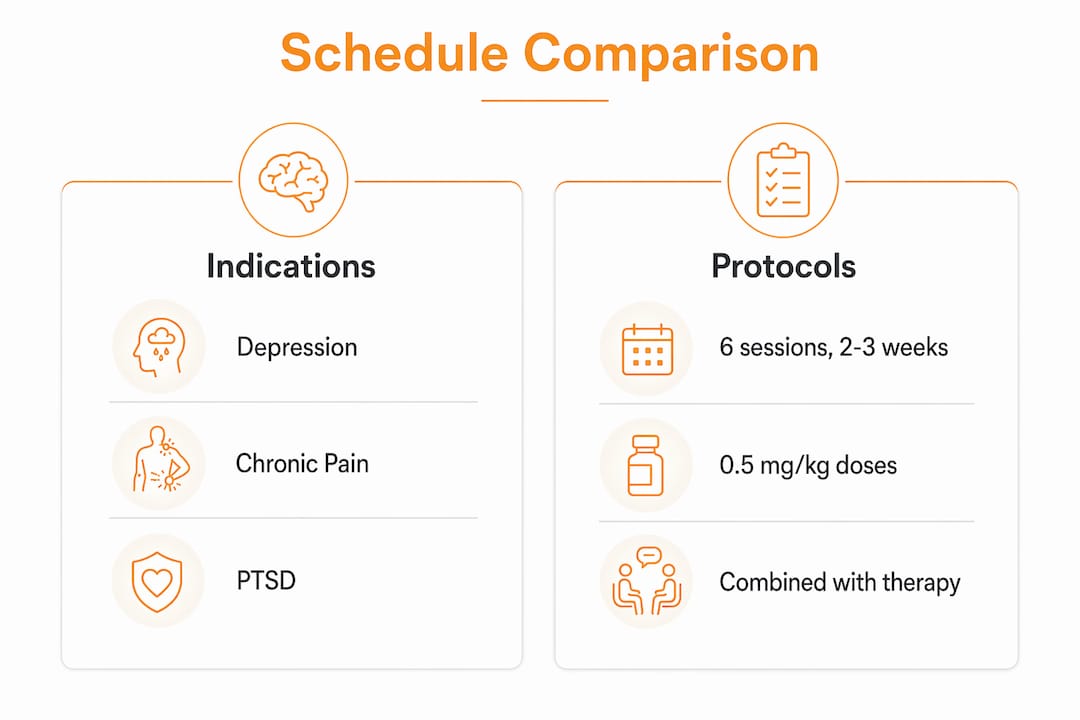
The most widely used induction protocol for depression and anxiety involves 6 IV ketamine infusions scheduled over 2 to 3 weeks, with sessions typically occurring 3 times per week. This spacing allows the brain to consolidate neuroplastic changes between sessions without losing therapeutic momentum. Each clinic visit lasts 2 to 3 hours, accounting for pre-session preparation, the infusion itself, and post-session observation before you are cleared to leave.

Chronic pain patients follow a different rhythm. Cleveland Clinic’s outpatient protocol delivers 0.5 mg/kg infusions over 40 minutes for five consecutive days, with nursing staff present throughout. That program has expanded to more than 50 infusions per week since 2021, which demonstrates how feasible a daily consecutive schedule can be when the clinical infrastructure supports it. The consecutive-day model works for pain because the goal is to reset central sensitization, a process that benefits from sustained dosing rather than spaced intervals.
For PTSD, the scheduling picture is more complex. Protocols combining ketamine with exposure therapy use 6 infusions over 2 weeks at 3 sessions per week, with 5 separate exposure therapy sessions scheduled on non-infusion days. This staggered design prevents overlap and lets each modality do its job without competing for the patient’s cognitive and emotional bandwidth.
Comparing common session schedules by indication
| Indication | Session count | Frequency | Total duration |
|---|---|---|---|
| Depression / anxiety | 6 infusions | 3x per week | 2 to 3 weeks |
| Chronic pain | 5 infusions | Daily (consecutive) | 1 week |
| PTSD (with exposure therapy) | 6 infusions + 5 therapy sessions | 3x per week infusions, separate therapy days | 2 weeks |
| Ketamine-assisted psychotherapy | 3+ dosing sessions + integration sessions | Flexible, often weekly | 3 to 6 weeks |
The key variable across all of these is why you are being treated. Your diagnosis, medical history, and response after early sessions all shape how your provider adjusts the schedule going forward.
Pro Tip: Ask your clinic whether they use a fixed 6-session protocol or an adaptive one. Adaptive protocols adjust dosing and frequency based on your response after sessions 2 and 3, which may produce better outcomes for patients with complex histories.
What preparatory steps are needed before scheduling sessions?
Scheduling ketamine therapy is not simply booking calendar slots. Each session requires specific preparation that, if missed, can force a cancellation and disrupt the entire series.
- Complete a medical and psychiatric screening. Patient selection requires psychiatric and medical stability, including a review of current medications, cardiovascular health, and psychiatric history. This screening determines whether you are a candidate and informs the dosing strategy.
- Plan your fasting window. You must avoid eating for at least 2 hours and avoid liquids for 30 minutes before each session to reduce nausea risk. Build this into your daily schedule for every appointment in the series, not just the first one.
- Arrange transportation for every session. Ketamine impairs reaction time after treatment, and you cannot drive yourself home. This is not optional. Arrange a driver or rideshare for each appointment before you finalize your schedule, because a missing ride is one of the most common reasons sessions get delayed or rescheduled.
- Block 2 to 3 hours per appointment. The full visit requires a 2 to 3 hour block that includes paperwork, pre-session assessment, the infusion, and post-session monitoring. Do not schedule work calls, childcare pickups, or other obligations within 4 hours of your appointment start time.
- Schedule integration therapy in advance. If your protocol includes ketamine-assisted psychotherapy, book both the dosing sessions and the integration therapy appointments before your series begins. Therapist availability is often the bottleneck, and waiting until after your first infusion to find a slot means you may miss the optimal processing window.
Pro Tip: Create a simple calendar template before your series starts. Mark every infusion day, every integration session, every fasting window, and every transportation arrangement in one place. Patients who plan logistics in advance are far less likely to miss sessions or arrive unprepared.
How do you structure ketamine sessions combined with psychotherapy?
Ketamine-assisted psychotherapy, commonly called KAP, is a distinct protocol from standalone infusion therapy. University of Utah Health recommends at least 3 ketamine dosing sessions paired with integration therapy sessions, often scheduled the same day or shortly after dosing. Each dosing session runs approximately 1 hour, followed by a roughly 1-hour integration session where you process the experience with a therapist. Booking both as a combined appointment series is the standard recommendation because the therapeutic window closes quickly.
For PTSD specifically, the scheduling logic becomes more deliberate. Research combining ketamine infusions with written exposure therapy used infusion days separated from therapy days to prevent cognitive overload and maximize the effect of each modality. In that open-label trial, 69% of patients showed substantial symptom improvement sustained at 12 weeks post-treatment. That result came from a carefully staggered schedule, not from stacking both treatments on the same day.
The coordination challenge in combined protocols is real. Your infusion provider and your therapist need to communicate directly about your schedule, because a conflict between their calendars becomes your problem. Clinics that offer both services under one roof, or that have established referral relationships with therapists, reduce this friction considerably.
Scheduling maintenance sessions after the initial series
After completing an induction series, many patients require periodic maintenance infusions to sustain their response. Maintenance sessions are typically scheduled every 4 to 8 weeks, though the interval is adjusted based on how long your relief lasts after each session. You can learn more about how long infusion effects last to set realistic expectations before planning your maintenance calendar. The key principle is to schedule the next maintenance session before your symptoms return to baseline, not after.
Integrating mindfulness and CBT between infusion sessions is another scheduling consideration that many patients overlook. These practices reinforce the neuroplastic changes ketamine may support, and they work best when practiced consistently during the weeks between sessions rather than sporadically.
What are common scheduling challenges and how do you fix them?
Even well-planned series encounter obstacles. Knowing the most common problems in advance lets you solve them before they derail your treatment.
- Missed sessions disrupt therapeutic momentum. Ketamine’s effects on neuroplasticity appear to be cumulative during an induction series. Skipping a session or extending the gap between sessions may reduce the overall benefit. If you must reschedule, contact your clinic immediately to find the earliest available slot rather than waiting until your next scheduled date.
- Side effects affect next-day functioning. Some patients experience fatigue, mild dissociation, or emotional sensitivity in the 24 hours after a session. Schedule demanding work or social obligations on non-infusion days, particularly during the first week of your series when you are still learning how your body responds.
- Therapist and infusion provider calendars conflict. When your KAP protocol involves two separate providers, scheduling conflicts are common. Resolve this by designating one person, ideally a care coordinator at your clinic, to manage both calendars. If your clinic does not offer this service, ask your therapist to hold recurring slots for your integration sessions before your infusion series begins.
- Underestimating recovery time per session. Patients frequently book obligations too close to their appointment end time. The post-session observation period is not a formality. It is a clinical requirement that varies by patient and session. Build a buffer of at least 1 hour beyond your expected discharge time for every appointment.
“The most effective ketamine treatment plans are built around the patient’s life, not just the clinic’s calendar. Flexibility in scheduling, combined with clear communication about side effects and recovery time, is what keeps patients on track through a full series.”
Patients who combine ketamine with talk therapy consistently report better long-term outcomes than those who treat infusions as standalone events. The schedule is the structure that makes that combination possible.
Key takeaways
Effective ketamine therapy scheduling requires matching your session frequency and sequencing to your specific diagnosis, then protecting every appointment with logistics planning that accounts for fasting, transportation, and recovery time.
| Point | Details |
|---|---|
| Standard induction series | Most depression and anxiety protocols use 6 sessions over 2 to 3 weeks at 3 sessions per week. |
| Chronic pain uses daily scheduling | Cleveland Clinic’s pain protocol runs 5 consecutive daily infusions, a distinct rhythm from mood disorder protocols. |
| PTSD requires staggered scheduling | Infusion days and exposure therapy days must be separated to prevent cognitive overload and maximize each modality. |
| Logistics are clinical requirements | Fasting, transportation, and 2 to 3 hour appointment blocks are non-negotiable safety requirements, not preferences. |
| Integration therapy must be pre-booked | Schedule psychotherapy integration sessions before your series begins, since therapist availability is often the limiting factor. |
What I’ve learned about scheduling from the clinical side
After working with patients across a wide range of conditions, the scheduling mistakes I see most often are not about picking the wrong protocol. They are about underestimating how much the logistics matter. A patient who arrives fasted, has a driver confirmed, and has their integration therapy booked is already in a fundamentally different position than someone who is figuring those things out on the day of their first session.
The other thing I have observed is that patients sometimes push to compress their schedule, wanting to finish the series as fast as possible. That impulse is understandable. When you are dealing with treatment-resistant depression or PTSD, you want relief now. But the spacing between sessions exists for a reason. The brain needs time to consolidate what the ketamine is facilitating. Rushing the schedule does not accelerate healing. It often dilutes it.
What actually works is a thorough evaluation before the first session, a realistic conversation about what the recovery window looks like for each appointment, and a clear plan for what happens after the induction series ends. Maintenance scheduling is where a lot of patients fall off. They feel better, they stop coming in, and then they are surprised when symptoms return. The maintenance phase is part of the treatment, not an optional add-on.
My practical advice: treat your ketamine series like a medical procedure with a recovery protocol attached to each session, because that is exactly what it is.
— Austin
Start your ketamine series with the right plan at NeuroRelief

NeuroRelief Ketamine & Infusion Therapy in Sherman Oaks serves patients throughout Los Angeles, including Beverly Hills, Santa Monica, Pasadena, and the San Fernando Valley, with physician-led IV ketamine protocols for depression, anxiety, PTSD, and chronic pain. Dr. Austin Harris, a board-certified cardiothoracic anesthesiologist trained at UC Irvine and Keck Hospital of USC, oversees every treatment plan personally. The clinic provides scheduling support, integration therapy coordination, and individualized dosing strategies so your series is built around your needs from day one. Explore your ketamine treatment options or learn about ketamine-assisted psychotherapy to take the next step toward a structured, supported treatment plan.
FAQ
How many ketamine sessions are in a standard series?
Most induction protocols for depression and anxiety involve 6 IV ketamine sessions scheduled over 2 to 3 weeks. Chronic pain protocols, such as the one used by Cleveland Clinic, may use 5 consecutive daily sessions instead.
Can you drive yourself to and from ketamine therapy appointments?
No. Ketamine impairs reaction time after treatment, and patients must arrange a driver or rideshare for every session in their series. This is a clinical safety requirement, not a preference.
How long does each ketamine therapy appointment take?
Each visit typically requires a 2 to 3 hour block, including pre-session assessment, the infusion itself, and post-session monitoring before discharge. Plan your day accordingly and avoid scheduling obligations within 4 hours of your appointment.
When should integration therapy be scheduled relative to infusions?
University of Utah Health recommends scheduling integration therapy the same day as or shortly after each dosing session to maximize the therapeutic benefit of processing the ketamine experience while it is still fresh.
How are maintenance sessions scheduled after the initial series?
Maintenance infusions are typically scheduled every 4 to 8 weeks after the induction series, with the interval adjusted based on how long symptom relief lasts for each individual patient. The goal is to schedule the next session before symptoms return to baseline.